
 Tucked away in the rolling hills near Hwy 41 just north of Allenton, Dominion Valley Farm, is home to Brandon and Tammera Dykema and their 4 sons.
Their motto, "Fresh from our farm to your table", isn't just a catchy marketing slogan. It exemplifies their commitment to providing their customers with the highest quality beef, pork, turkey, chicken and duck products possible.
Dominion Valley Farm is this week's "Favorite Local Find of the Week"!
Brandon, thanks for taking the time to share with us about your farm, particularly your focus on the "old-fashioned" technique of raising pastured animals.
Q1. Brandon, how did you become interested in farming?
I wasn't raised on a farm, but by the time I was in 3rd or 4th Grade I knew that I wanted to be a farmer. About 10 years ago in 1997, we purchased the farm. I hadn't planned on farming, though. I was actually looking at doing a compost business.
Organics is a huge part of that whole concept so I did a lot of reading and researching on the subject. I pretty much just educated myself.
This was actually a good thing because I didn't start off farming using the conventional methods. I learned many of the techniques we now use mostly just by doing them, but I've also had some wonderful mentoring from other more seasoned farmers/producers.
Q2. How did you actually get started with all of this?
Our first year we raised chickens strictly for our own consumption. Each successive year we added more birds including ducks and turkeys. This is actually a good way to begin as the start-up costs are quite reasonable, and it's not a huge risk.
Q3. How does your feed and your treatment of the animals differ from that of the typical feedlot or chicken factory farm?
Pasturing is key as it completes the nutritional needs of the animals, giving the meat a better taste.
Our pigs are born out in the pasture. They don't need the standard iron shots given at birth as do the conventionally-raised pigs since the pastured piglets are able to get their iron from their environment, the dirt, along with many other beneficial nutritional elements.
The pastured pigs also get a lot more exercise. This makes for a better quality of meat as the muscles are well-developed.
Chickens, turkeys, and ducks thrive in the natural sunlight and fresh air. In the pasture they also get several sources of protein. Some of it comes from their feed, besides three or four more types of protein from the grasses and bugs.
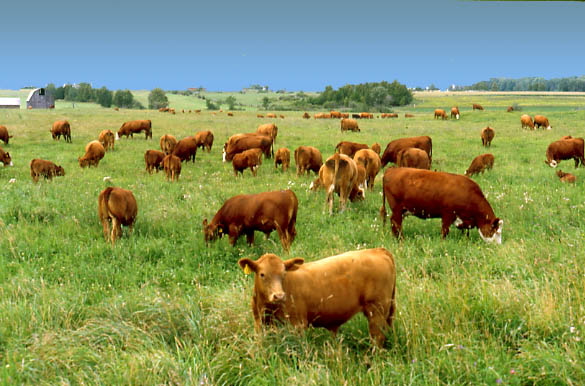
Our beef is strictly grass-fed except in the winter when they eat hay. This means that their diet is not supplemented with antibiotics, growth hormones, synthetic chemicals, or grain.
I like to focus on a diversity of feed that will produce good, healthy tasty meat. The pigs, for example, normally take about six weeks to finish. I provide them with turnips which work very well as they will initially eat off the tops. Then once the tops grow back, they will again eat them along with the root. We also grow our own rape. It's like a cabbage without a head, and it's very juicy. The pigs love it!
We grind our own feed fresh from whole grains purchased from a neighbor. The ground feed stays fresh for only about 1 1/2 weeks. After that the food value drops considerably which is why I don't grind it too far in advance.
Q4. What can you tell us about the particular breeds of animals that you are raising?
We bought our original Galloway Beef back in 2000-2001 from the Castners (Kay's HomeFarm). The Galloway breed is not a well-known breed in America but is beginning to be more popular among graziers. It is traditionally raised on grass and hay--not in a feedlot.
The majority of our turkeys are the Broad-Breasted White Turkey. They are pretty standard. We also have Heritage Turkeys. Both types of turkeys have the same appetite for the lush pasture, something they would never get in a barn.
We are wanting to get more of the Tamworth breed of pigs. This is an older breed which always does better on pasture. Good hogs don't fit into the cookie cutter way of raising pigs. As a result good breeds are few and far between.
We've got the "pasturing" down. Now we are trying to get the "breeding" down.
Q5. How much poultry do you normally raise on your farm?
All of our poultry is strictly pastured-based. We raise them throughout the spring, summer and fall. Nothing over the winter for obvious reasons!
We like to raise them in a group of 300-400 at a time. We get them at a day old and start them in the brooder. When they are the right size we bring them outside, and the next new group of chicks are put in the brooder with the cycle starting all over again.
During the summer we will normally raise between 3,000 and 4,000 chickens all at various stages of growth. We also raise 500-600 ducks and 250-300 turkeys.
We normally schedule our fall butchering dates in March. The butchering is handled by a state-inpsected poultry plant in Cascade. This allows us to sell to anyone without any restrictions such as restaurants, at Farmer's Markets, or on-site farm sales.
It is interesting to note that we have customers who drive up from Illinois. The cost of organic food there is so high that it is cheaper for them to purchase their meat from us.
Q6. How do you divide up the chores?
I mostly do the “outdoor” share of the work, although I usually write the marketing brochures and our newsletter.
The boys are learning. They help around the farm and with other tasks as well. Our oldest son has been taking on more responsibility at the Farmer’s Market. He started out doing change. Now he does all of that besides talking to the customers. He knows and understands our techniques here and is able to raise interest in those who are just passing by. He is learning some great “lifeskills”.
Tammera handles the “inside” part of the business. She’s involved in organizing and marketing our family business. We direct market our products so she coordinates all of that: keeping up with the phone calls, emails, requests, orders, etc.
It definitely is a team effort! I couldn’t do this business without her, and she couldn’t do it without me.
Q7. What are your dreams and/or goals for your farm?
We want to be able to expand our production by possibly renting more land. Our desire is to have enough meat on hand that we will never have to tell someone that our meat is sold out.
We are committed to keeping our animals happy and healthy by making sure they have the pasture that is necessary for them to produce the healthiest meat. We'd also like to be able to offer more individual cuts of our meats.
It is our goal to provide more diversity for our customers.
Thanks, Brandon, for all the great information about the wonderful benefits of "pasturing"--not only for your animals, but also for everyone that consumes them!
Check out the Dominion Valley Farm website for more information about the cuts and varieties of meats, prices, availability, and their contact information.
A couple of nights ago we baked one of DVF's Bronze Ranger Chickens. It was rather an unorganized meal with everyone eating at slightly different times!
Soon after I decided that I'd better put away the leftovers before they went bad, but the only thing waiting for me in the kitchen were dirty dishes!
I was fortunate that I had grabbed a piece of the chicken before anyone else had gotten to it.
That was some finger-linkin', bone-pickin', good chicken!
Sunday, October 21, 2007
Pasture Perfect

Subscribe to:
Post Comments (Atom)




No comments:
Post a Comment