
That's exactly how those involved in the local food iniatitives feel about the Farmer Chef Connection. It's like reuniting family members who've been apart far too long!
It is encouraging to hear about the extraordinary gains of the Buy Fresh, Buy Local campaigns in the last couple of years. This movement has now spread to 25 states.
Robert Carp, the keynote speaker, has been working in this field for 12 years. He made a number of interesting observations regarding this development.
He believes that "hunger" is fueling the movement.
Hunger for connection--our modern society is characterized by "disconnection". In contrast there is a whole community evolving around the local food movement which connects consumers to their food as well as those who produce and/or cook it.
Hunger for soul food--the beauty, texture and flavor that comes from local foods. They are often referred to as "Food with a Face", or "Food with a Story". Knowing the person or story behind the food gives it both a "face" and a "story".
Finally, hunger for empowerment--there is pleasure in the feeling of making a difference in the world. We do have the power to affect the quality of life for ourselves, our families, our communities, and the animals we consume by taking positive action in eating food produced locally.
There is no doubt about it that there are significant challenges ahead for the Local Food Movement. Much of the infrastructure has been lost over the years, such as the processing plants and efficient distribution centers.
Mr. Karp also asked two important questions:
Q1. How can we grow this movement without winding up industrialized?
Competitive pressures are becoming stronger as more farmers are moving towards the whole idea of "sustainable" food production. (And don't forget that the big corporations are also trying to get in on a cut of the "organic" market!)
The local food producer needs to look not at his fellow local food producers as the competition. The competition is the big food corporations.
The goal should be to establish long-term loyal relationships which foster communication, cooperation, and professionalism.
Q2. How can this movement be financed to insure that it will last?
Investments are going into the demand side and not to the supply side. There is a need for creative financing-working on developing partnership between investors and organic farmers.
"Social" financing where the investor gets a modest long-term return, but is willing to do that because he knows his money is going for a greater cause--helping to support the growth of healthy, local food and as a result the local economy, is an option currently being discussed.
Jack Kaestner, Executive Chef at the Oconomowoc Lake Club, was the moderator of the Farmer Chef Panel discussion. He said that there are also challenges from the chef's side of the equation.
1. The owners of the restaurants are, of course, looking for food that is cheaper and what would appear to be better value for the money.
Locally produced foods because of not being mass produced, etc. can be more costly.
2. Restaurants are set-up on industrialized food sources. They are used to ordering from standardized orders/price lists of the big food distributors. They can make an order and have it at the door within the same day.
In sharp contrast is all the logistics of purchasing, delivery, etc. of the products of possibly 20-30 different local farmers/vendors while still allowing the chefs to get their meals cooked and into the dining room at the appropriate time!
Chef Kaestner is committed to seeing this happen though as the local food movement figures out a way to streamline this whole process, but still maintain the integrity of the food served.
He actually purchased 25% of his food from local markets last year!
"It's more than just putting local food on your plate, though. It's rebuilding a relationship with the local farmer. Chefs today are rethinking their entire menus," he said.
Chef Leah Caplan of the Washington Hotel Restaurant & Cooking School from Washington Island in Door County also talked of the efforts they've spearheaded up there, and the progress that has been made with the local food movement.
Of course, her biggest challenge is her location, but the initiatives that they've undertaken are pretty amazing.
Her definition of "local" is anything that can be on the dinner plate the same day!
Another area which needs a paradigm shift is the premium that chefs put on tenderloin and what they consider the better cuts. The premium should be that it is locally grown meat.
The shift needs to be not just to buying particular "cuts" BUT to purchasing and using the variety of "cuts" from the whole animal.
Chefs/restaurants need to emphasize the flavor and freshness of the local foods on their menus, and the support that is provided for the local farmer and his family, which in turn supports the local economy.
Yes, there are many challenges on both sides for the farmer and the chef alike, but the benefits to both of them as well as the consumers are well worth the time and effort spent to reconnect these two important elements in our society today.
Most people in the Midwest are not far from the farm, maybe only one or two generations. In fact, it was mentioned in the opening remarks that 80% of people surveyed feel that small farmers are important.
Think about how much of every culture's interactions revolves around food. It is no wonder that good nutrition is so incredibly important.
We are overwhelmed as a nation by the upswing of chronic diseases that are sabotaging our quality of life and are taking precious family member's and friend's lives every day.
The growth of the local food movement over the past couple of years shows us that people are trying to make that connection back to agriculture. I mean "real" agriculture, not what is being passed off as agriculture by the big agri-businesses of today!
The third and final part of the Farmer Chef Connection was the Family Farm Showcase. This was a unique opportunity to meet and connect with the "faces" behind the food! What a fantastic group of committed individuals. I'm looking forward to highlighting many of them in the future!
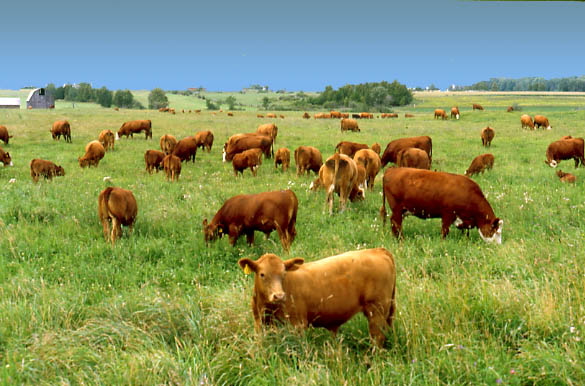
It was also an opportunity to sample some of the finest pasture-raised meat grown right here in Southern Wisconsin. This included Highland Beef, Galloway Beef, Piedmontese Beef, varieties of poultry, and also lamb.
There were also samples of honey, maple syrup, apples, various vegetables, artisan cheese, ice cream and other dairy products, sorghum, even some vodka and gin! The colors, varieties and flavors were amazing!
Actually, it was the best food I've ever eaten at any family reunion I've ever attended!
Sunday, October 28, 2007
Family Reunion

Subscribe to:
Post Comments (Atom)




No comments:
Post a Comment