

I've spent several posts already talking about the horrific conditions surrounding the commercialized meat processing system in our country.
What a nightmare these animals must endure almost for the entirety of their abbreviated lifespan!
It is obvious that these animals raised for our consumption are afforded little, if any, "enforced" protection by law.
This speaks volumes regarding the "priorities" of the meat industry, as well as the apathetic outcry against the unethical treatment of these animals.
Yet there is another inhumane factor which is often overlooked but also needs to be addressed. It is the treatment of this industry's workers.
Working conditions in the "factory farms," just one aspect of the whole system, are not only incredibly unhealthy but also extremely dangerous.
Think about just the concentrated manure fumes from literally thousands upon thousands of confined animals. These contain highly toxic gases. It is no wonder that:
As many as 25% of all workers at confined animal feeding operations experience chronic bronchitis, while up to 70% will have acute bronchitis at some point during the year.
And this is probably "minor" when contrasted with some of the other more dangerous side effects of the toxic air which permeates these facilities.
Then consider that in 1996:
The rate of repeated-trauma disorders at meat-packing plants was 27 times higher than the national rate for private industry as a whole, and almost six-and-a-half times the rate for all manufacturing jobs.
In 1995, meat-packing workers suffered injuries at a rate of 22.7 per 100 worker, making meat-packing the seventh-most dangerous industry in the United States in terms of non-fatal injury.
I wanted to see if I could find any more up-to-date stats, and I came across this eye-opening report, Blood, Sweat & Fears: Workers' Rights in U.S. Meat and Poultry Plants . This is a lengthy 185-page publication by the Human Rights Watch written in 2005. (Does that picture look familair?)
They point out several reasons why this type of work is extremely dangerous: Line Speed, Close-Quarters Cutting, Heavy Lifting, Sullied Work Conditions, Long Hours, and Inadequate Training and Equipment.
They also share real life-documented experiences to support each one of these charges. Interestingly, they are able to effectively rebut this industry's claims denying that the above-mentioned issues are a problem.
As I said, it was a real eye-opener!
I have not read the entire report from cover-to-cover yet so I can't vouch for everything that is in it, but certainly the sections I read had much to say about the perilous conditions these workers face day in and day out.
So what can I do about all of this?
I read an intriguing article describing what some ordinary people just like me are doing. These critical issues have become increasingly more important to producers and consumers alike of many different faiths.
Here's just one little excerpt from the article. I recommend reading it in its entirety.
Christians, Jews and Muslims who see food through a moral lens are increasingly organized and focused on showing their strength. The Religious Working Group on the Farm Bill, a national coalition of more than a dozen religious organizations, is lobbying Congress for legislation to help small farms. The National Catholic Rural Life Conference is helping congregations and universities in the Midwest buy local produce from family farmers.
It seems that their faith demands them to take action regarding environmental issues, humane treatment of animals, and the ethical treatment of workers.
A particularly controversial topic in the Jewish faith these days, Heksher Tzekek, concerns the rewriting of the kosher certification rules in order to address the ethical treatment of the animals, the workers and the environment.
It is encouraging to see many people of different faiths, different ethnic backgrounds, from all walks of life raising their voices to say,
"Enough! There is a better way! We must support more ethical, healthier ways to raise our food, treat our fellow man, and create a safe, healthy environment for our present generation and the generations to come!"
For myself personally, now that I'm aware of the abuses of the current meat processing system, I can no longer for health reasons, or in good conscience purchase meat from the major meat producers. Even the advertised "All-Natural" meat is suspect as far as I'm concerned!
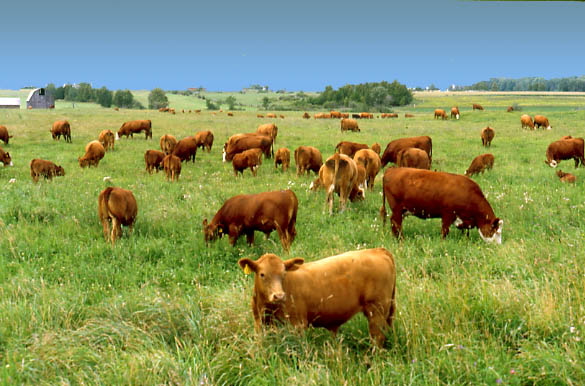
My family is making every effort to buy local meat that is birthed, raised and butchered by those who are committed to producing high-quality, affordable, ethical products that they can feel proud to stake their names and reputations on!
I've met many such fine, dedicated people just in the past few weeks since I started this blog, and I look forward to getting to know many other equally qualified local producers in the months to come.
I invite you to join me and this exciting, growing network of informed and concerned consumers by supporting these fine farmers and retailers listed in "My Favorite Local Links!" featured on the sidebar!
My "local" emphasis has become somewhat of a joke between my husband and I. When I tell him that we need to go to the farm now, he asks, "Which one?"
Wednesday, October 10, 2007
Enough Already

Subscribe to:
Post Comments (Atom)




3 comments:
Well, actually we're not rewriting the kosher certification rules at all, that is just the accusation being leveled by some of our opponents. The ritual rules which must be followed in order for food to be considered kosher are not the issue. The goal of Hechsher Tzedek is to add an additional hechsher, a righteous mark, which would appear next to the hechshers already in use.
This additional mark on the packaging which would let kosher consumers know that the food they are purchasing was produced not just according to Jewish ritual laws, but also according to Jewish ethical laws.
The details are still in the works, but the broader categories have been identified:
wages and benefits
health and safety
training
environmental impact
product development
corporate transparency
With the major Jewish Holidays behind us for another year, we are back to work on this initiative. We can't drop the ball now!
Thanks for the clarification.That sounds like a mark we could use on all of our food!
That is why buying local is SO important to me. I want to know the producers personally.
I can see firsthand the way they treat their animals. They aren't fudging with the truth, or using all kinds of synthetic chemicals that produce the biggest animal in the shortest amount of time!
Ethical treatment of workers is not an issue with most of these local farmers since they are doing most,if not all of the work by themselves or with the help of family members. From what I've observed so far I wouldn't have any doubt that if they did have employees, they would treat them well.
I see the how they plant and harvest their crops, knowing that they are not inundating them with all kinds of pesticides, herbicides and whatever other "cide" that is guaranteed to produce bigger and better crops.
I know that they are not using genetically modified seeds or anything else that would harm the environment or another human being. This is their land, their livelihood, their food, and their families we are talking about!
As a consumer doing all that I can to avoid the various chronic diseases which are epidemic in our country, I demand better.
I am thrilled that I have found it right in my own backyard.
I probably could have used this for another post! Pardon me, while I jump down off of my soapbox!
I hope that soap box is filled with locally produced soap which isn't harmful to the environment in any way! I would be reeally disappointed in you otherwise....
Did you ever wonder where the expression came from? They must have had much sturdier boxes at one time. If you stood on them today you wouldn't look very impressive!
OK I'll go away and leave you in peace...Say hi to everyone for me.
Post a Comment