
 How am I qualified to make such a statement?
Here's some descriptive initials that could be tacked on after my name: C.M. and/or I.C.
They stand for Concerned Mom and/or Informed Consumer.
I've become part of a select group of consumers who demand healthful, quality products for myself and my family.
No wonder Kay's HomeFarm Meats is my "Favorite Local Pick of the Week"!
I contacted Kay when I found out that Kay's Meats were one of the top-selling items at Slowpoke's Local Food Store.
Obviously, there had to be something special about this meat!
When I explained to Kay my passion for finding and promoting good local food sources, she immediately invited me to come over for a tour. It was a fascinating, educational afternoon with this top-notch lady!
It all started back in 1987 when Steve and Kay Castner bought 50 acres of land just northwest of Cedarburg near Cedar Creek. Kay is now retired after teaching math for 38 years. The last 25 were at Cedarburg High School. Steve is an attorney.
Q1. Kay, how did you as a teacher make the transformation to a farmer?
After we purchased our land and built our home on the property, my husband bought me a border collie puppy. When she got bored, she got into all kinds of trouble. That was when we purchased 12 ewes to give her something to keep her occupied.
Even though we secured them with a 5-wire fence, if just one lamb managed to slip through the wires, the whole flock also got out. Their thick wool protected them from the electric shock.
After several episodes of this, as well as the price of wool going through the floor, Steve began doing some research on beef. That was when we purchased our first four Black Galloways.
About the time we started with the sheep, Steve became interested in managed intensive grazing, also called rotational grazing.
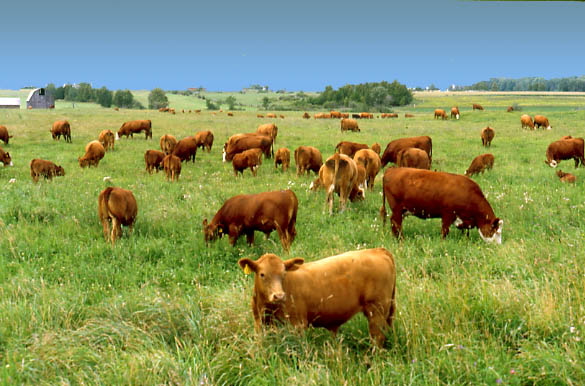
We divided our pastures into approximately one-acre paddocks. This allowed us to move the animals almost daily through each one of the paddocks, and by the time they got back to the first paddock it had plenty of new growth to start another rotation. We have been doing this now for 13-14 years.
Q2. How does this rotational grazing impact the nutritional value of your Black Galloways?
Grass-fed beef is nutritionally superior to grain-fed beef. Our beef are 100% grass-fed! Cattle are naturally grass-fed animals. That is the way they are designed.
Grain is not a part of their normal diet. They only became grain-fed in the last 50-60 years.
Q3. Are you certified organic?
No, we are not. It is very costly, and we would rather put those resources back into our operation here. We actually prefer using the term "sustainable".
This means low inputs--no use of fertilizer, very little use of tractors and fuel, no maintenance antibiotics, and no growth hormones.
Q4. Kay, why did you choose the Black Galloway breed?
First of all, Galloways have a double-hair coat. This keeps them warmer in the winter. Our beef are never housed, although we do have winter paddocks up near the barn where they are fed hay throughout the colder months of the year.
Secondly, they are great mothers. The regularly deliver their calves unassisted, and the calves thrive on their mother's good, rich milk. The earliest we wean them is at 6 months of age.
Also the bulls are fairly gentle. By the way, we use no artificial insemination.
Q5. Why do consumers like Galloway meat?
Taste and tenderness are the two biggest criteria in determining which meat the consumer will purchase.
Galloways have been tested out as producing very tender meat. They have a very fine muscle structure and are lean. Their double-hair coat keeps them warmer so they don't put on a lot of body fat in the winter. Galloway meat is juicy and delicious, too.
Q6. Kay, please tell us a little more about your herd.
Right now, we have maximized our pasture and have maintained the number in our herd. Our strategy is to try to keep a ratio of one animal per one acre.
We normally have around 25 breeding females, 10 young females, 20 steers and 2 bulls.
Speaking of the bulls: Kay proudly points out to us Nolan, their 6-star bull. A private company does DNA testing on the tail hair in order to verify the genetic lineage of the offspring. Nolan comes from a long line of superior purebred Black Galloways.
Nolan was also tested for tenderness. He is currently classified in the top 2% of all bulls for all breeds!
Congratulations, Nolan and Kay! That is quite a distinction and an honor!
Q7. Very quickly, Kay, what do you sell?
We sell our beef in 25-pound boxes. We have 6 pick-up days a year. All of the dates as well as the available cuts of meat are listed on our website. You can order by email or over the phone at 262-375-1702 .
Thanks for all the great information, Kay. You obviously take a great deal of pride in your operation and your livestock.
What a beautiful area! It was almost park-like, except for those cow pies that we had to dodge now and then. The cattle grazed peacefully nearby, watching us curiously as we moved from paddock to paddock.
It was such a stark contrast to the deplorable conditions that I've been reading about in the typical feedlot!
By the way, while I've been working on this post, my family has been downstairs preparing some of the ribeye steaks that we got from Kay last week.
Just had a thought! Is it possible that "smell" isn't another important critieria when it comes to great meat?
Tenderness, great taste, and a delectable smell! Kay's HomeFarm Meats have it all!
Sunday, October 7, 2007
I Give It 6 Stars

Subscribe to:
Post Comments (Atom)




No comments:
Post a Comment