
Slaughterhouse! This final horrendous fate is still awaiting these poor, unsuspecting creatures.
Actually, there is no let-up to their misery. The next step preceding the slaughterhouse is commonly referred to as "The Transport".
After enduring the inhumane conditions of the infamous feedlot, the cattle will be taken to one of two destinations: a livestock market or a slaughterhouse.
During this transit time the animals are carefully loaded into a padded, air-conditioned or heated, spacious compartment with food and water in abundance.
Yes, their comfort is of utmost importance. It is necessary to guarantee the safe arrival of our future hamburgers and steaks in one piece. No bruising or broken bones allowed.
In their dreams!
Unfortunately, the sight of all these overcrowded cattle trucks crisscrossing our highways and interstates is an all too common sight.
Who hasn't driven past one of these smelly trucks crammed to the max with livestock whose noses are straining to catch just the tiniest whiff of fresh air?
I was not aware until recently that the only federal law that pertains to the transporting of animals for food production purposes allows them to be transported up to 36 hours without food or water. This law does not even address the issue of overcrowding abuses.
Death, injury and disease are accepted industry standards during the transporting and marketing processes. Every year, hundreds of thousands of animals collapse from the cruel conditions and can no longer stand.
It is so common that the meat and dairy industry even have a name for these animals,"downers".
These animals are commonly left in alleyways or unloading docks without food, water or veterinary care, until it's convenient to take them to slaughter--usually the next day. In many cases, the animals die of neglect.
Any wonder? Thirty-six hours on the road without food or water with another 12-24 hours of continued deprivation is more than the already-weakened animal can tolerate.
It became my mission to find out what the current policies in place are regarding "downers", and if they are still being processed as food by the meat industry.
I read how legislation was passed that was supposed to protect "we the people", but somehow during the passage of the bill the part banning "downers" from ending up in our food supply was removed.
Then in February 2006, there was a report released which stated: U.S. Beef inspectors have failed to fully comply with rules banning cattle that are unable to walk to safeguard consumers from mad cow disease, allowing at least 29 such animals, including 20 high-risk "downers", to reach the food chain, according to a recent government audit.
Were "downers" banned or not?
Finally, I found it! In an article dated July12, 2007:
The U.S. Department of Agriculture's Food and Safety and Inspection Service (FSIS) today announced a permanent prohibition on the slaughter of cattle that are unable to stand or walk ("downer" cattle) when presented for pre-slaughter inspection. The inability to stand or walk can be a clinical signal of Bovine Spongiform Encephalopathy (BSE).
Under the rule, cattle that are injured after they pass pre-slaughter inspection will be reevaluated to determine their eligibility for slaughter.
I suppose I should be reassured. Permanent prohibition--huh! But with how many other exceptions and/or exemptions?
Quite honestly, I'll take my local food producer's meat any day!
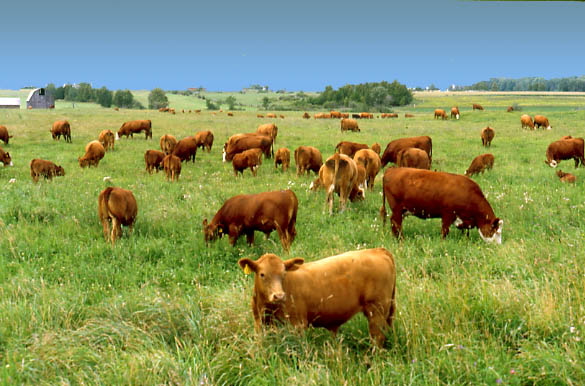
The only time I've ever noticed any "downers" in their pastures, they've been savoring the warm sunlight, breathing in the fresh air and every so often lowering their heads long enough to grab another mouthful of fresh green grass!
Thursday, September 27, 2007
Out of the Feedlot into the ....

Subscribe to:
Post Comments (Atom)




No comments:
Post a Comment